


How to Choose the Right Violin Teacher for Your Child
Choosing a violin teacher for your child involves more than checking credentials. Here's what actually predicts whether lessons will stick — and how to find the right fit through trial lessons.
In This Guide
- A Great Violinist Isn't Always a Great Teacher
- Look for a Teacher Who Builds Strong Fundamentals
- A Good Teacher Trains the Ear, Not Just the Fingers
- How the Teacher Connects With Your Child
- Ask About the Teacher's Approach to Practice
- Match the Teacher to Your Child's Goals
- Try More Than One Teacher
- Questions to Ask in a Trial Lesson
Starting violin lessons is exciting for both kids and parents. But once you actually start looking for a teacher, the search can feel overwhelming fast.
Should you choose a conservatory-trained violinist? Someone with decades of experience? A private instructor who comes to your home? An online teacher with great reviews?
There's no shortage of talented musicians out there — but finding the right teacher for your child comes down to more than credentials or an impressive résumé.
A Great Violinist Isn't Always a Great Teacher
One of the most common assumptions parents make is that the best performer will automatically be the best teacher. Playing well and teaching well are two different skills.
A professional violinist may have outstanding technique, but working with a young beginner takes patience, communication, and the ability to break a difficult concept into steps a child can actually follow.
For beginners especially, the teacher needs to know how to break down posture, bow hold, rhythm, and intonation into simple, manageable pieces.
Look for a Teacher Who Builds Strong Fundamentals
Violin is an instrument where small habits matter. Unlike an instrument with fixed pitches, such as piano, violin students have to learn to create accurate pitch themselves — all while developing bow control, posture, coordination, and rhythm at the same time.
That's why a strong beginner teacher won't rush from one song to the next just to show progress. A good teacher takes the time to build the basics correctly, even when that means slower visible progress at first.
Comfortable, balanced posture
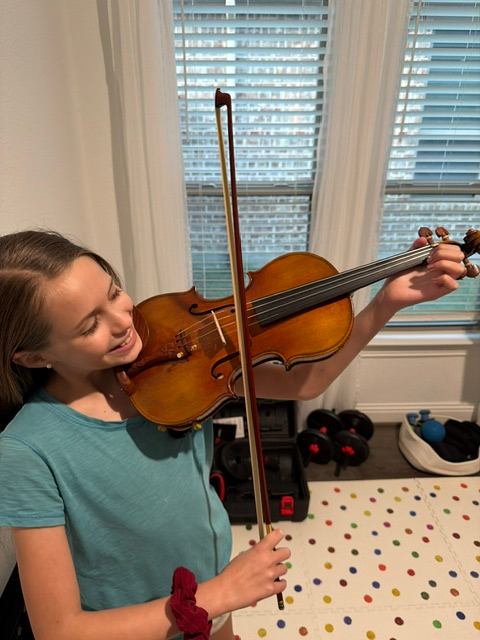
Proper violin and bow hold
Clear tone production
Rhythm and coordination
Listening and pitch awareness
Relaxed movement, without unnecessary tension
Progress may look slower at first, but strong fundamentals almost always make future learning easier.
A Good Teacher Trains the Ear, Not Just the Fingers
Young students can easily fall into the habit of memorizing finger placement without really listening to the sound they're producing. A thoughtful teacher builds ear training in from the start — singing notes, listening for pitch differences, playing along with recordings, or asking a student to notice when something sounds too high or too low.
Why this matters: Violin has no frets to show exactly where each note falls, so ear training is especially important. Over time, strong listening skills are what make a student a more independent musician.
How the Teacher Connects With Your Child
For young students, personality matters almost as much as teaching ability. Children learn best when they feel comfortable enough to make mistakes, ask questions, and try again. Lessons don't need to feel like a game, but they shouldn't leave a child feeling constantly nervous or discouraged either.
During a trial lesson, here's what to watch for:
Does the teacher explain things in a way your child understands?
Does your child seem at ease asking questions?
Are mistakes corrected patiently, not sharply?
Does the teacher notice when your child is confused or losing focus?
A strong teacher also knows when to challenge a student and when to slow down — and your child should leave the lesson motivated to try again.
Ask About the Teacher's Approach to Practice
For most beginners, progress depends heavily on what happens between lessons. A good teacher gives clear, specific practice instructions instead of simply saying "practice more" — for example:
What a clear assignment sounds like: "Play this four-measure section three times slowly," or "practice the bow movement on open strings," or "listen to the recording before playing the piece." Specific goals make practice far less frustrating for both children and parents.
If your child is very young, it's also worth asking how involved you should be during at-home practice.
Match the Teacher to Your Child's Goals
Not every student has the same reason for learning violin. Some children simply want music as a hobby. Others may want to join a school orchestra, audition for a youth orchestra, compete, or eventually study music in college. There's no single correct path — the goal is finding a teacher whose expectations match your child's.
Playing for Enjoyment
- Relaxed pacing focused on fun and steady progress
- Repertoire chosen around what your child enjoys
- Less pressure around competitions or exams
Serious Performance Goals
- Structured technique and audition preparation
- Experience with competitions and advanced repertoire
- Clear benchmarks for progress
Try More Than One Teacher
Choosing a violin teacher doesn't have to be a permanent decision after one lesson. Trial lessons give you a real sense of the teacher's style and let your child see whether the relationship feels comfortable — before you commit.
Questions to Ask in a Trial Lesson
How do you usually teach beginners?
A professional teacher should be able to walk you through their typical progression for a new student, from first lesson onward.
What method books or materials do you use?
Look for a clear, consistent method rather than a loosely improvised lesson plan.
How much daily practice do you recommend?
Expectations should match your child's age and current level, not a one-size-fits-all number.
How do you work with students who lose motivation?
This reveals how patient and adaptable the teacher will be during the inevitable slow stretches.
Do you offer recitals or performance opportunities?
Performance opportunities, even informal ones, help build confidence over time.
How involved should parents be during lessons and practice?
Answers vary widely by teacher and by your child's age — worth clarifying up front.
How do you know when a student is ready for more advanced material?
A thoughtful answer here shows the teacher pays attention to fundamentals, not just repertoire.
Learning violin isn't a race. Progress is rarely a straight line — some weeks everything clicks, and others the same passage feels impossible. The right teacher helps a child work through both, and combines musical knowledge with patience, structure, and a real understanding of how your child learns.
When those pieces come together, violin lessons become more than notes and songs. They build confidence, listening skills, and a lifelong relationship with music.
Once you've found the right teacher, the right instrument makes early lessons easier too.
Shop Beginner Violins