


Why Learn Violin in the Age of AI? A Human Skill AI Can't Replace
Why the Violin Still Matters
AI can write, draw, and even compose music in seconds. So what's left that's truly ours? The answer might be sitting in a case in your closet.
In This Article
AI can write an essay in seconds. It can generate an image, summarize a book, draft an email, and solve a math problem before you've finished reading the question. It can even compose music that sounds surprisingly polished.
For a lot of people, that's exciting. For others, it's a little unsettling. Because if machines can do so much of the "thinking" work for us, a quiet question starts to show up:
What's still truly ours?
The answer probably isn't on a screen. It's in something slower, harder, and a lot more human — something like the violin.
The Question AI Can't Answer
Modern life trains us to expect speed. Food shows up in 30 minutes. Videos last 15 seconds. Apps promise instant answers. Online courses claim you can "master" almost anything in a month.
Bit by bit, we start believing fast is better, easy is smarter, and slow is outdated. Then AI shows up and speeds everything up even more. Need a paragraph? AI writes it. Need an idea? AI brainstorms it. Need a song? AI generates something that already sounds finished.
Here's the strange part: the more AI can do for us, the more valuable it becomes to do something it genuinely can't do in our place — not just produce a result, but become the kind of person who can create one.
That's where the violin comes in.
Why Playing Violin Uses Your Whole Self
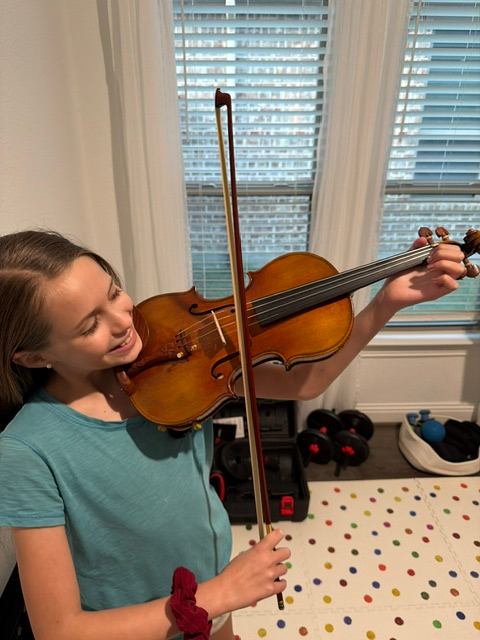
Anyone who has picked up a violin knows the truth: it doesn't hand out quick rewards. At first, the sound might be scratchy. The bow might shake. Even one clean note can feel out of reach.
That's not because you lack talent. It's because the violin asks for something rare — it asks your whole self to show up.
Your eyes
Aren't just reading notes — they're scanning ahead, getting ready for what's coming next.
Your ears
Aren't just hearing pitch — they're judging tiny differences in tone, rhythm, and balance in real time.
Your mind
Is tracking key, timing, fingering, bow direction, and musical phrasing all at once, while staying present with the sound.
Your body
Fingertips, wrist, shoulder, bow weight, arm balance, even your breathing — all quietly working together.
And through all of it, you're constantly adjusting: that note was a little sharp, that bow stroke was too heavy, that phrase needs more air. Learning violin isn't one skill — it's a full-body conversation between attention, movement, sound, memory, and feeling.
AI can imitate the finished sound of music. It can't live through the slow, physical process of becoming a musician.
AI vs. the Violin: What Each One Actually Gives You
It helps to see the difference side by side. AI is genuinely useful — but it's built to shortcut effort. The violin is built to reward it.
What AI Gives You
- A finished result in seconds
- Output without physical effort
- A shortcut around the learning curve
- Something you can copy or generate again instantly
What the Violin Gives You
- A skill that lives inside your own hands
- Patience, focus, and real listening ability
- Progress you earn one repetition at a time
- A sound that carries your own effort — impossible to fake
Why "Hard" Matters More Now, Not Less
In the past, learning something difficult was usually practical. You studied writing because you needed to write. You learned a trade because you needed a skill. Today, AI can handle a lot of those practical outputs on its own.
That doesn't make human learning pointless — it changes what learning is for. The value of learning violin isn't only that you'll eventually play a song. The value is what happens to you while you're learning it.
Worth Remembering
Some skills are valuable precisely because they can't be rushed. In American culture, we already admire this instinct — the athlete training before sunrise, the craftsman who spends years on one skill, the musician who plays the same eight bars two hundred times until it finally clicks.
The violin doesn't flatter you. It doesn't hand you a shortcut, and it doesn't reward pretending. It just asks you to come back, again and again, with honesty — tune carefully, listen closer, accept the imperfect note, and try once more.
What You Actually Gain From Learning Violin
After three months, you might still be working on basic tone. After three years, you might feel like you're only beginning to understand the instrument. That can feel discouraging in a culture built around instant results — but that's exactly the point. Here's what's actually building in the background:
- Patience that carries over into everything else you do
- Sharper focus and a longer attention span
- The ability to really listen — to music, and to people
- Sensitivity to small differences most people miss
- Comfort with failing, adjusting, and trying again without giving up
None of that can be downloaded. It has to be earned, one practice session at a time.
AI Can Create Music. It Can't Practice For You.
AI may be able to generate a track that sounds finished. But it can't feel the tiny vibration of a string under a fingertip, or the frustration of a hard passage finally smoothing out, or the quiet pride of one beautiful note after weeks of work. It can't stand in a room with a real instrument, a real body, and a real moment of attention.
That's the difference. The violin isn't only about music — it's about presence. It pulls you back into the physical world and asks you to stay with something long enough for it to change you.
In that light, picking up the violin in the age of AI isn't old-fashioned. It might be one of the most modern choices you can make — because when everything around us gets faster and lighter, choosing something slow, difficult, and deeply human becomes its own kind of statement.
Is it too late to start learning violin as an adult?
Not at all. Adult beginners learn differently than kids — often faster in some ways, since you already understand practice, patience, and how to set goals. Plenty of adult students go from zero to playing simple songs within a few months of regular practice.
Can AI tools actually help someone learn violin?
Yes, in supporting roles — apps can help with tuning, rhythm practice, or tracking progress. But AI can't replace the physical practice of bowing, fingering, and ear training that only comes from playing a real instrument yourself.
How long does it take to sound "good" on violin?
Most beginners can play simple, recognizable songs within 3 to 6 months of consistent practice. Comfortable tone and intonation usually take 1 to 2 years, and that's completely normal — the violin has one of the longer learning curves of any instrument, which is part of what makes progress feel so earned.
Ready to start your own slow, deeply human skill?
Shop Beginner Violins