


5 Posture Tips to Improve Your Violin Playing (From a Master Who Knew)
If your playing has hit a plateau, your technique might not be the problem — your posture might be.
Violin legend Aaron Rosand (1927–2019) spent decades distilling the fundamentals of great playing into practical, no-nonsense guidance. Born in Hammond, Indiana, Rosand made his orchestral debut at age 10 performing the Mendelssohn Violin Concerto with the Chicago Symphony Orchestra. He later studied at the Curtis Institute of Music under the legendary Efrem Zimbalist, and went on to hold the Dorothy Richard Starling Chair professorship at Curtis from 1981 — eventually receiving an honorary doctorate for his extraordinary contributions to violin pedagogy.
Before he passed, Rosand shared five foundational posture principles on his blog. They're simple. They're direct. And they work.
1. Look Like You Know What You're Doing
Stage presence starts before the first note. When a performer looks confident and in control, the audience believes in them — and that belief can make or break a performance.
Ask yourself before you walk out: Does my posture project confidence, or doubt?
2. Standing Position: Ground Yourself, Free Your Music
- Keep your weight shifted slightly onto the left leg, balancing naturally with the violin resting on your left shoulder
- Feet should be 12–14 inches apart — not too wide
- Keep your knees soft and flexible, never locked; your right leg should stay relaxed
- If your right leg steps forward during a phrase, always bring it back — don't wander around the stage
- Think of Heifetz and his legendary stillness: your attention belongs on your hands and the music, not your feet
3. Sitting Position: Sit Tall, Sound Full
- Keep your back straight and point the scroll toward the audience — not toward the brass section
- Let your gaze travel naturally from the fingerboard toward the scroll
- Avoid slouching, spreading your legs, or crossing them — these all restrict your movement and sound
- Make sure your bow arm has full range of motion, and keep the tip of the bow parallel to the bridge
4. Holding the Violin: Ditch the Shoulder Rest
This is Rosand's most provocative — and perhaps most important — point.
"Use a shoulder rest? Heifetz would tell you to go play the cello."
Menuhin made the same argument in writing: the violin belongs on the collarbone. Most of the great masters played without a shoulder rest, and for good reason.
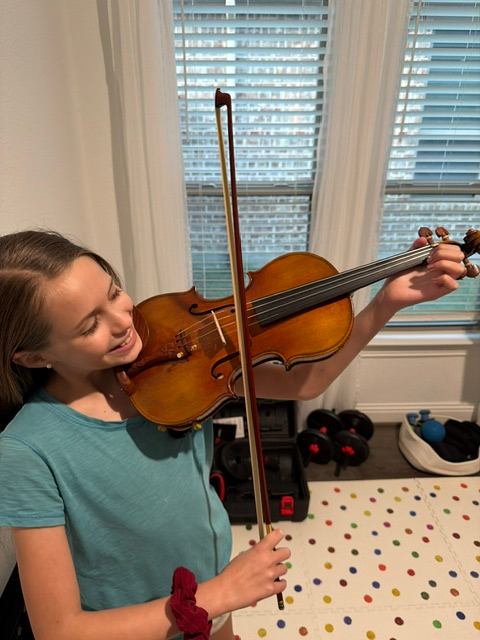
Here's what proper hold looks like:
- The violin rests on the collarbone, with the left shoulder free to move slightly and the left elbow tucked under the body of the instrument
- This keeps the left-hand fingers in the ideal position for dynamics and vibrato
- Rest the violin against the fleshy part of the left jaw; on fast or descending passages, the chin can gently shift downward
- Stay relaxed throughout — don't grip the neck with the left hand; leave room between the jaw and the instrument for shifting
- With the shoulders gently curved inward, the bow's natural weight does the work — no need to press
The shoulder rest problem: A shoulder rest pushes the right arm outward, forcing you to apply extra bow pressure to compensate. Over time, this leads to a harsh, one-dimensional tone — and the sacrifice of all the subtle nuance and inner texture that makes playing truly musical.
5. Posture and Breathing: Comfort Is the Goal
- Stand or sit tall — hunching compresses your back and kills your tone
- Breathe naturally and evenly — never hold your breath while playing
- The real secret to improvement: stay as comfortable as possible at all times
- If you feel pain in your neck, back, or arms, stop and figure out why before continuing
Pain is a signal, not something to push through. Correct the root cause, and your progress will accelerate.
The Bottom Line
Aaron Rosand's five principles aren't complicated — but they're profound. Whether you're a student or a seasoned performer, it's worth taking a hard look at your posture. Great sound starts with a great foundation.
Recommended related articles
What Level Can You Reach After One Year of Violin Lessons? A Complete Guide
Six Essential Tips for Beginners Practicing Violin Fingerings