


How to Get a Bigger Sound from Your Violin?
Learning to relax the muscles along the back of your bow arm so that the natural weight of your arm can sink freely into the strings — this is the insight a seasoned violin teacher passed on to me. Everything I learned from him is captured in what follows. Read on, and you are sure to take something valuable away.

The Difference Between Bow Pressure and Bow Weight
What exactly is bow pressure? What is bow weight? These two concepts are often confused, but understanding the difference is the key to unlocking a fuller, more powerful violin tone.
Imagine your right arm is a construction crane. The crane lifts heavy materials into the air using cables attached to the back of the crane arm. Now imagine those cables suddenly snap. The load would come crashing to the ground with tremendous force — that is the natural weight of the arm at work.
The same principle applies to playing the violin. By relaxing the muscles along the back of your right arm, you allow the full natural weight of your arm to transfer into the strings. The muscles at the back of your upper arm are what hold your arm up in the first place. The more you release that tension, the more weight naturally sinks into the string.
This is the core idea: a relaxed bow arm produces a bigger, richer sound. You do not need to press harder or use more muscular force. In fact, excessive tension in the arm is precisely what prevents a full sound from developing.
Practical Exercises to Feel Bow Weight
Developing a feel for bow weight takes time and deliberate practice. Here are two exercises that help students experience it directly.
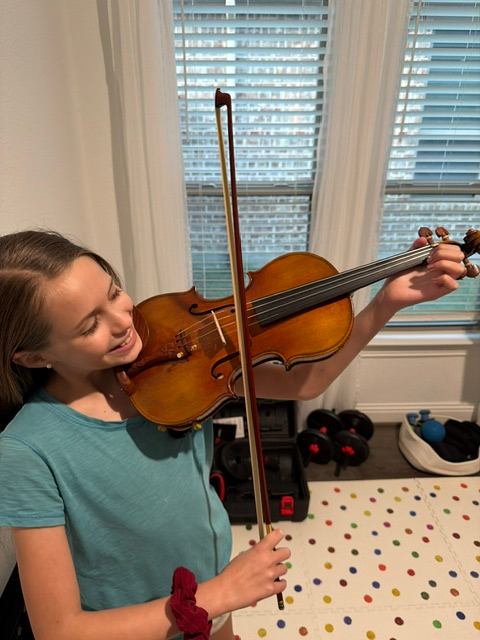
Start by playing short double stops on open strings at the frog. Because the bow is short and close to the frog, it is much easier to feel the arm's weight dropping naturally into the strings. Once that sensation is clear, gradually lengthen the bow stroke while maintaining the same feeling of natural weight. The goal is to carry that sense of relaxed heaviness throughout the entire bow.
This feeling must be practiced consistently until it becomes a natural habit. It will not happen overnight, but with focused repetition it will become the foundation of your sound production.
The Three Most Important Principles of Bowing
In my years of teaching, I have found that great bowing technique comes down to three essential principles.
The first principle is that the bow must always travel parallel to the bridge. This is non-negotiable and must be maintained at all times.
The second principle is using arm weight rather than pressure to drive the bow. As described above, releasing tension in the back of the arm allows natural weight to engage the string, which is what produces a strong, resonant tone.
The third principle is the ability to immediately relax after applying effort. This is one of the most frequently overlooked principles in violin teaching. If a student's bow arm remains tense after initiating a stroke, it is almost always because this principle has not been fully understood or internalized.
Finding the Right Contact Point
One of the most common problems I see in students of all levels is poor contact point placement. The contact point refers to where the bow hair meets the string, and most students place it far too close to the fingerboard. When the bow travels over the fingerboard rather than between the fingerboard and the bridge, the resulting sound is weak, airy, and lacks carrying power. It also makes it impossible to use full arm weight without the tone collapsing or cracking.
The reason students default to playing near the fingerboard is often a lack of a clear internal sound concept. If you do not know what a powerful, projecting tone actually sounds like, you will not know you are missing it.
Think about what it means to play as a soloist with a full symphony orchestra. Your sound must cut through dozens of instruments and reach every corner of a concert hall. That kind of projection requires playing closer to the bridge, using full arm weight, and having a clearly defined mental image of the sound you are trying to produce.
Your Inner Sound Concept Comes First
The most important lesson in violin tone production is this: your internal concept of the sound you want determines everything about how you play. Technique is not the starting point — your sonic goal is.
If you can hear in your mind exactly what kind of sound you want, your body will begin to find the means to produce it. The method follows the intention. This is what I mean when I say that purpose determines technique.
There is still much more to explore on the topic of violin tone, particularly the third principle — the balance between effort and immediate relaxation in the bow arm. That principle will be the focus of our next discussion.